
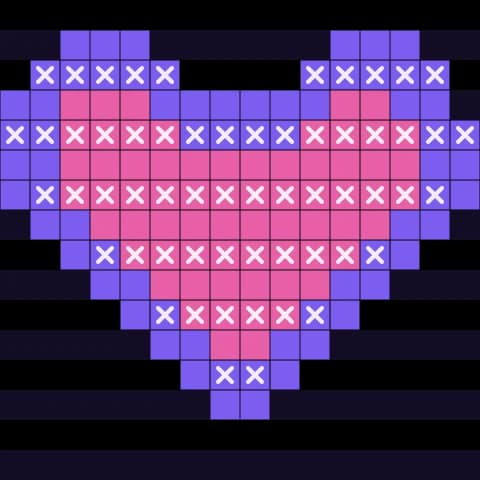
 Mosaic crochet
A mosaic crochet pattern maker that checks every stitch
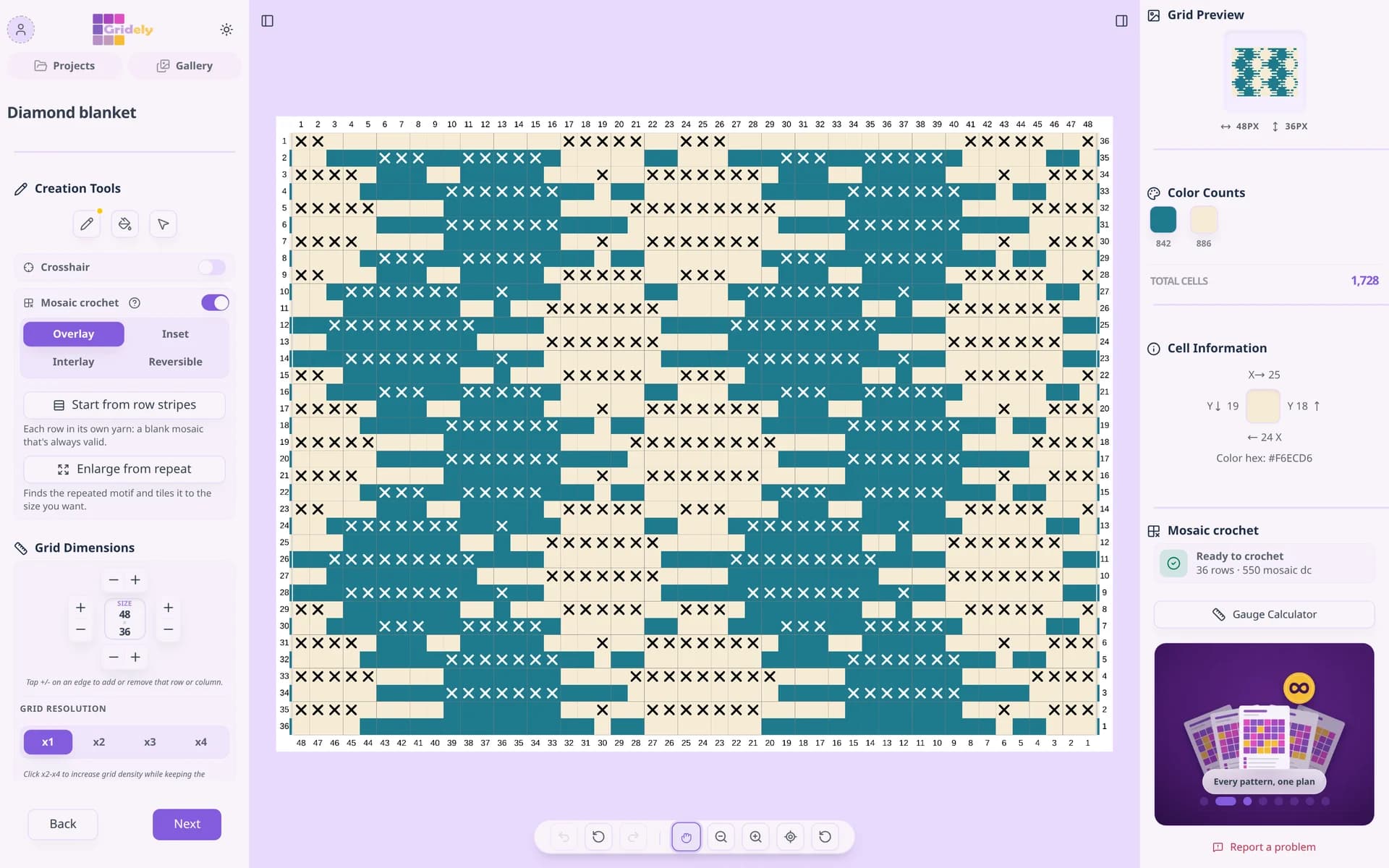
Paint the design you want to see. Gridely places every mosaic stitch for you, tells you straight away if a square can't be crocheted, and fixes it in one click — for overlay, inset, interlay and reversible mosaic.
- Start without an account
- Free charts up to 500×500
- Works on phone, tablet and desktop
What is mosaic crochet?
Bold geometric colourwork, with only one colour in your hands at a time.
Mosaic crochet builds striking two-colour designs without ever carrying two yarns at once. The rows simply take turns: one row in the first colour, the next in the second. The picture comes from a few long stitches that reach down into an earlier row and bring their colour with them.
On a chart, every square is one stitch. A plain square is an ordinary stitch in the row's colour. A square with an X is the long mosaic stitch — and because it covers the square just below it, that square ends up showing the other colour.
So the chart and the finished picture are two views of the same thing, and that is exactly where charting mistakes hide. Gridely shows you both at once and checks every square as you draw.
How to read it
- Each row is worked in one colour — the strip beside the chart shows which.
- X marks a mosaic stitch: it reaches down and gives its colour to the square below.
- Charts are read from the bottom up, starting on row 1.
Four ways to work mosaic crochet
Same idea, different hands. Gridely charts all four from the same design — switch at any time and your picture stays.
The bold, textured classic
Overlay mosaic
- Every row is worked from the front, so you never turn your work.
- The mosaic stitch is laid over the top, into the front of the stitch two rows below.
- You cut the yarn at the end of each row — many makers turn the ends into a fringe.
Best for a first mosaic project and for thick, cushiony blankets.
Flat, tidy and no ends to weave
Inset mosaic
- Each chart row is worked twice: out on the front (row a), then back on the reverse (row b).
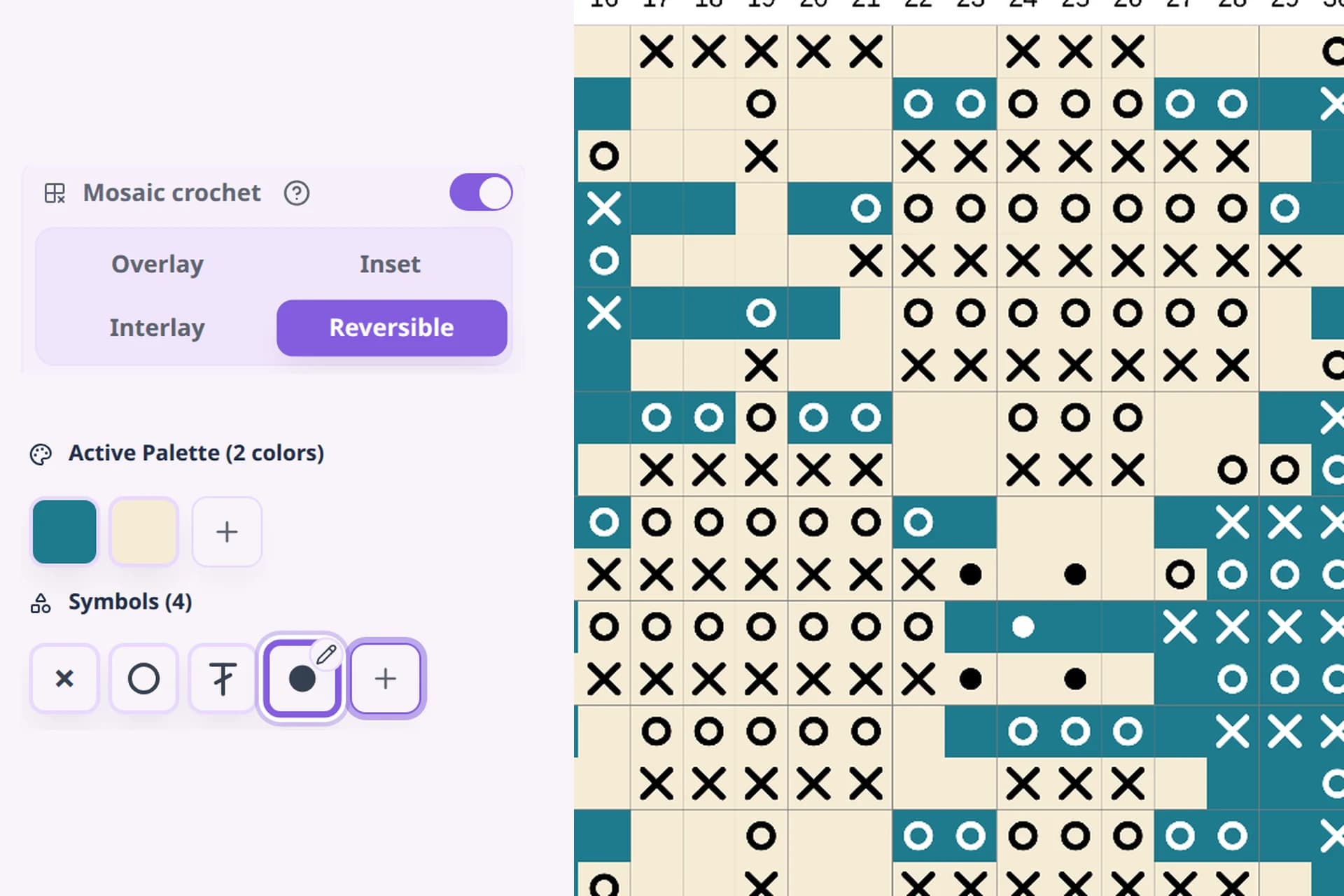
- Where the other colour should show, you chain and skip a stitch — marked ○ on the chart. A mosaic stitch fills the gap later.
- The unused yarn waits at the side, so there are no ends to cut.
Best for flatter pieces with a neat back, like cushions and wall hangings.
Inset's cousin, with a different weave
Interlay mosaic
- Worked like inset — two rows per colour, turning each time.
- The mosaic stitch wraps around the stitch below instead of going into the gap.
- Same chart as inset, a slightly firmer texture.
Best for inset fans who like a sturdier fabric.
A design on both sides
Reversible mosaic
- Overlay with one extra stitch: the stitch above each X is anchored to the back (marked ○).
- The back shows the design too — mirrored, in the opposite colours — with no loose loops.
- Also called mirrored or anchored mosaic. It uses a little more yarn.
Best for scarves, shawls and blankets seen from both sides.
| Overlay | Inset | Interlay | Reversible | |
|---|---|---|---|---|
| Rows per colour | 1 | 2 (there and back) | 2 (there and back) | 1 |
| Turn your work | No | Yes | Yes | No |
| Yarn ends | Cut every row | None | None | Cut every row |
| Chart symbols | X | X and ○ (chain) | X and ○ | X and ○ (anchored) |
| The back | Stripes | Neat and flat | Neat and flat | The design, colours swapped |
| Edge stitches | Usually plain | Always plain | Always plain | Usually plain |
How to read a mosaic pattern
The same small design, written out for each technique — exactly as Gridely prints it. Rows are worked from the bottom of the chart, right to left.
Overlay mosaic
Abbreviations
sc = single crochet in the back loop · mdc = mosaic double crochet: dc in the front loop of the stitch two rows below. Every row is worked on the right side: join the new yarn at the start, fasten off at the end.
Before row 1
Set-up row (Yarn B): ch 12, sc in 2nd ch from hook and in each ch across (11 sc). Fasten off.
Row by row
- Row 1 (Yarn A, RS): sc 11, fasten off (11 sts)
- Row 2 (Yarn B, RS): sc 7, mdc 4, fasten off (11 sts)
- Row 3 (Yarn A, RS): mdc 2, sc 9, fasten off (11 sts)
- Row 4 (Yarn B, RS): sc 7, mdc 4, fasten off (11 sts)
- Row 5 (Yarn A, RS): mdc 2, sc 9, fasten off (11 sts)
- Row 6 (Yarn B, RS): sc 7, mdc 4, fasten off (11 sts)
- Row 7 (Yarn A, RS): mdc 1, sc 2, mdc 4, sc 4, fasten off (11 sts)
Inset mosaic
Abbreviations
Each chart row is worked twice: row a on the right side, then turn and work row b back, carrying the yarn not in use up the side. sc = single crochet through both loops · ch, sk = chain over the skipped stitches · mdc = mosaic double crochet into the stitch skipped three rows below, in front of the chain. Row b: sc in each sc and mdc, ch over each chain.
Before row 1
Set-up rows (Yarn B): 11 foundation sc, turn; ch 1, sc in each st across (11 sc), turn. Carry the yarn not in use up the side.
Row by row
- Row 1a (Yarn A, RS): ch 1, sc 7, ch 3, sk 3, sc 1, turn (11 sts)
- Row 1b (Yarn A, WS): ch 1, sc 1, ch 3, sc 7, turn (11 sts)
- Row 2a (Yarn B, RS): ch 1, sc 1, ch 1, sk 1, sc 5, mdc 3, sc 1, turn (11 sts)
- Row 2b (Yarn B, WS): ch 1, sc 9, ch 1, sc 1, turn (11 sts)
- Row 3a (Yarn A, RS): ch 1, sc 1, mdc 1, sc 5, ch 3, sk 3, sc 1, turn (11 sts)
- Row 3b (Yarn A, WS): ch 1, sc 1, ch 3, sc 7, turn (11 sts)
- Row 4a (Yarn B, RS): ch 1, sc 1, ch 1, sk 1, sc 5, mdc 3, sc 1, turn (11 sts)
- Row 4b (Yarn B, WS): ch 1, sc 9, ch 1, sc 1, turn (11 sts)
- Row 5a (Yarn A, RS): ch 1, sc 1, mdc 1, sc 5, ch 3, sk 3, sc 1, turn (11 sts)
- Row 5b (Yarn A, WS): ch 1, sc 1, ch 3, sc 7, turn (11 sts)
- Row 6a (Yarn B, RS): ch 1, sc 3, ch 4, sk 4, mdc 3, sc 1, turn (11 sts)
- Row 6b (Yarn B, WS): ch 1, sc 4, ch 4, sc 3, turn (11 sts)
- Row 7a (Yarn A, RS): ch 1, sc 3, mdc 4, sc 4, turn (11 sts)
- Row 7b (Yarn A, WS): ch 1, sc 11, turn (11 sts)
Interlay mosaic
Abbreviations
Each chart row is worked twice: row a on the right side, then turn and work row b back, carrying the yarn not in use up the side. sc = single crochet through both loops · ch, sk = chain over the skipped stitches · mdc = double crochet around the post of the same-colour sc below, in front of the chain. Row b: sc in each sc and mdc, ch over each chain.
Before row 1
Set-up rows (Yarn B): 11 foundation sc, turn; ch 1, sc in each st across (11 sc), turn. Carry the yarn not in use up the side.
Row by row
- Row 1a (Yarn A, RS): ch 1, sc 7, ch 3, sk 3, sc 1, turn (11 sts)
- Row 1b (Yarn A, WS): ch 1, sc 1, ch 3, sc 7, turn (11 sts)
- Row 2a (Yarn B, RS): ch 1, sc 1, ch 1, sk 1, sc 5, mdc 3, sc 1, turn (11 sts)
- Row 2b (Yarn B, WS): ch 1, sc 9, ch 1, sc 1, turn (11 sts)
- Row 3a (Yarn A, RS): ch 1, sc 1, mdc 1, sc 5, ch 3, sk 3, sc 1, turn (11 sts)
- Row 3b (Yarn A, WS): ch 1, sc 1, ch 3, sc 7, turn (11 sts)
- Row 4a (Yarn B, RS): ch 1, sc 1, ch 1, sk 1, sc 5, mdc 3, sc 1, turn (11 sts)
- Row 4b (Yarn B, WS): ch 1, sc 9, ch 1, sc 1, turn (11 sts)
- Row 5a (Yarn A, RS): ch 1, sc 1, mdc 1, sc 5, ch 3, sk 3, sc 1, turn (11 sts)
- Row 5b (Yarn A, WS): ch 1, sc 1, ch 3, sc 7, turn (11 sts)
- Row 6a (Yarn B, RS): ch 1, sc 3, ch 4, sk 4, mdc 3, sc 1, turn (11 sts)
- Row 6b (Yarn B, WS): ch 1, sc 4, ch 4, sc 3, turn (11 sts)
- Row 7a (Yarn A, RS): ch 1, sc 3, mdc 4, sc 4, turn (11 sts)
- Row 7b (Yarn A, WS): ch 1, sc 11, turn (11 sts)
Reversible mosaic
Abbreviations
sc = single crochet in the back loop · mdc = mosaic double crochet, two rows below · anchored st = insert in the back loop, pull up a loop, then insert in the back loop of the stitch two rows below and finish as an sc. Every row is worked on the right side and fastened off at the end.
Before row 1
Set-up row (Yarn B): ch 12, sc in 2nd ch from hook and in each ch across (11 sc). Fasten off.
Row by row
- Row 1 (Yarn A, RS): sc 11, fasten off (11 sts)
- Row 2 (Yarn B, RS): sc 7, mdc 4, fasten off (11 sts)
- Row 3 (Yarn A, RS): mdc 2, sc 5, anchored st 4, fasten off (11 sts)
- Row 4 (Yarn B, RS): anchored st 2, sc 5, mdc 4, fasten off (11 sts)
- Row 5 (Yarn A, RS): mdc 2, sc 5, anchored st 4, fasten off (11 sts)
- Row 6 (Yarn B, RS): anchored st 2, sc 5, mdc 4, fasten off (11 sts)
- Row 7 (Yarn A, RS): mdc 1, sc 2, mdc 4, anchored st 4, fasten off (11 sts)
Last row: work each mdc as a dc at the front and an sc at the back — before the final yarn over, insert the hook into the back loop of the sc above and pull through.
What Gridely does for you
Everything a mosaic designer checks by hand, done as you draw.
Paint the picture, the X follow
Draw the design you want to see. Gridely works out where every mosaic stitch goes and marks it, the way published charts do.
Know before you crochet
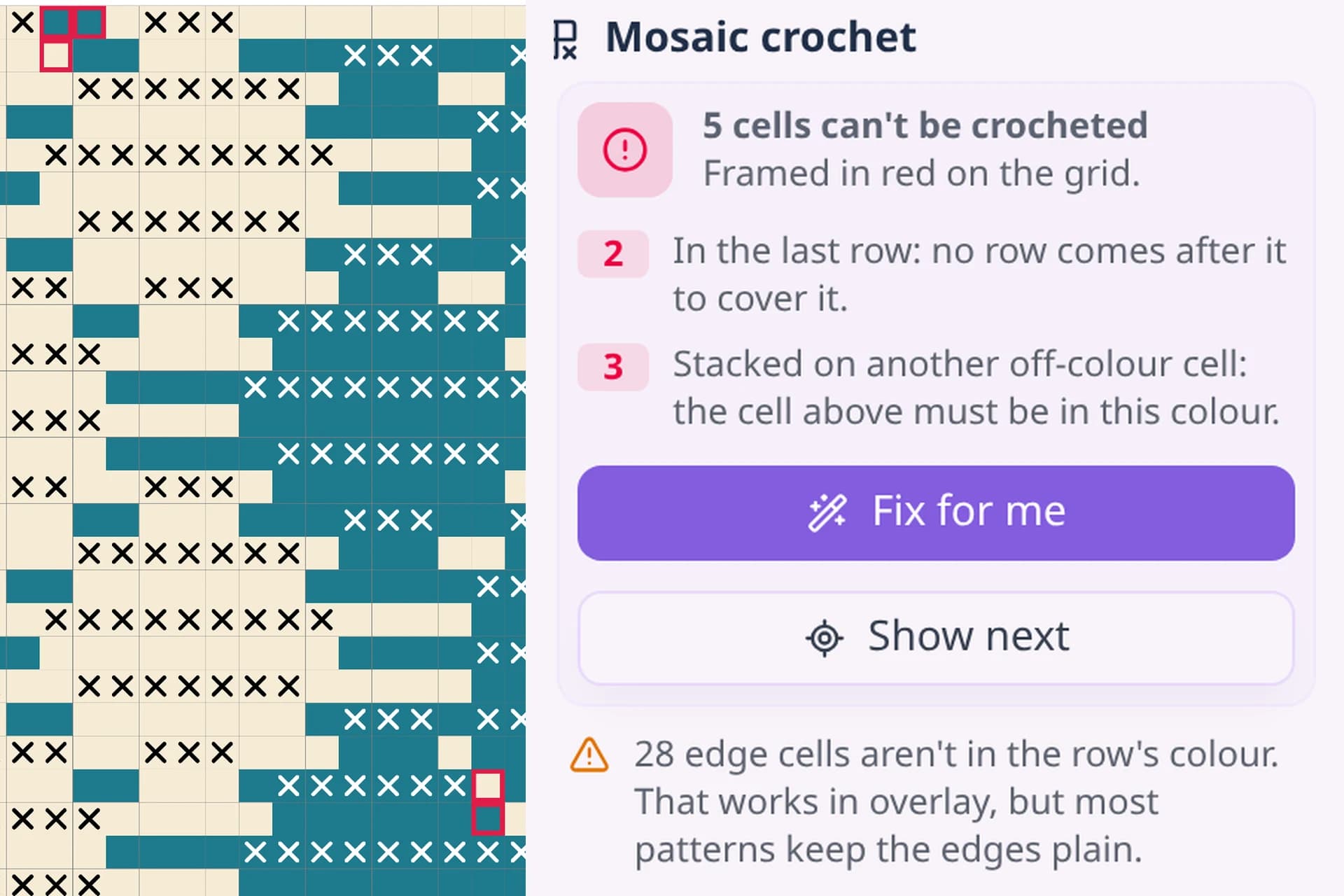
Every square is checked as you draw. Anything that can't be worked is framed in red with a plain reason, and one button takes you to each in turn.
Fix it for me
One click finds the fewest changes that make the whole chart workable, and shows you before and after so you decide.
Draw with stitch symbols
Place X and ○ yourself and the colours rearrange to match. Add your own symbols — standard crochet stitches or shapes — each with its meaning in the key.
One design, four techniques
Switch between overlay, inset, interlay and reversible at any time. The picture stays; the chart, its symbols and the instructions follow.
Start fast, grow big
Begin from row stripes, or let Gridely find the repeating motif and stretch your design to any size, edges kept. No repeat? Select the motif yourself.
Bring in a chart you already have
Upload a photo or a picture of a mosaic chart and Gridely reads the colours and the X and ○, then opens it ready to edit.
Follow it row by row
The reader shows the row you're on, its yarn and its stitches in order — and for inset, both halves of each row in the right direction.
Print it like a pattern book
PDF, PNG and SVG with every symbol, labelled rows and a key naming your yarns. Inset charts in compressed (1a / 1b) or full style.
A chart you can trust
Mosaic has rules: a square can only change colour if the stitch above reaches down to it, and the top row has nothing above it. Gridely keeps track of all of it. Squares that can't be crocheted are framed in red, each with its reason, and Fix it for me sorts them all out with the smallest possible change.
Your symbols, your key
Draw X and ○ straight onto the chart, or add standard crochet symbols — chain, slip stitch, single, half double, double and treble crochet, decreases, back and front loop — and simple shapes for beads or extra colours. Each one carries its meaning into the printed key.
From idea to finished piece
Three steps, whichever technique you choose.
- Step 1
Start your design
Turn on mosaic crochet in the editor, choose your two yarns, and start from stripes, from a picture, or from a chart you already have.
- Step 2
Draw and check
Paint the picture or place the stitches yourself. Problem squares stay framed in red until the chart is ready to crochet.
- Step 3
Crochet or share
Follow it row by row in the reader, or export a pattern with your symbols, row labels and yarns.
Mosaic crochet pattern maker — questions
Is the mosaic crochet pattern maker free?
Yes. Designing, checking and reading mosaic charts are free, on charts up to 500×500 squares. Exporting needs a free account and includes a watermark; clean exports come with the Studio plan or a one-off unlock for a single pattern.
Which mosaic technique should I start with?
Overlay is the usual first project: every row is worked from the front, and the chart is the easiest to follow. Try inset when you want a flatter fabric and no ends to weave in.
Can I turn an overlay chart into an inset one?
Yes — it's the same design. Switch the technique and Gridely redraws the symbols and instructions. Inset needs plain edge stitches, so it will point out any edge square to change.
Why does the editor say a square can't be crocheted?
A square can only show the other colour if a mosaic stitch reaches down to it from the row above, so it can't happen in the top row or on two squares stacked on top of each other. Fix it for me finds the smallest change that solves it.
One chain or two over a skipped stitch?
Designers do both. Pick ch 1 or ch 2 per skipped stitch in the reader and the written rows follow your choice.
Can I import a mosaic chart from a book or a photo?
Yes. Upload a picture of the chart, turn on Mosaic chart, and Gridely reads the colours and marks and opens it in mosaic mode. For a blurry photo, frame the chart by hand first.
What do sc and mdc mean in the written rows?
In overlay, sc is a single crochet in the back loop and mdc a mosaic double crochet: a dc in the front loop of the stitch two rows below. Every row is worked on the right side — join the new yarn at the start and fasten off at the end. Reversible adds the anchored stitch: insert in the back loop, pull up a loop, then insert in the back loop of the stitch two rows below and finish as an sc. In inset and interlay each chart row is worked twice, a on the right side and b back on the wrong side, carrying the yarn not in use up the side; ch, sk chains over the skipped stitches, and the mdc goes into the stitch skipped three rows below (inset) or around the post of the same-colour sc below (interlay), in front of the chain. In the reader, an sc shows as the row's yarn and an mdc as the chart's X.
Compressed or full chart?
A compressed chart has one row per colour, worked as 1a and 1b. A full chart draws every worked row, on the grid and in print. Painting either row of a pair paints both, so the design stays the same — switch any time.
How do I start a new mosaic design?
Start from row stripes: each row in its own yarn, a blank mosaic that's always valid. Then paint the picture. To change a yarn's colour, change it in the palette.
Can I make my mosaic pattern bigger?
Yes. Enlarge from repeat finds the repeated motif and tiles it to the size you want, keeping the edges as they are. If no repeat is found, drag over one motif on the chart and it will be repeated.
Does it work for mosaic in the round?
Not yet — Gridely charts mosaic worked in rows today. Rounds are on our list.
Other free pattern tools
Same editor, same chart — set up for a different craft.
 Photo to cross stitchConvert a photo into a stitchable chart with a DMC legend.
 Crochet pattern makerC2C, graphgan and tapestry charts with a row-tracking reader.
 Pixel art makerDraw on a blank grid or pixelate a photo with a palette you pick.
 Knitting chart makerColorwork charts for Fair Isle and intarsia, with a row reader.
 Hama & Perler bead patternsTurn a picture into a fuse bead pattern sized to your pegboards.
 Bead loom patternsLoom and square stitch charts from a photo or a blank grid.
 Latch hook patternsRug and cushion charts from a photo, with yarn counts per colour.
 Diamond painting patternsYour own photo as a drill chart with DMC codes.
 Needlepoint patternsCounted canvas charts from a photo, sized to your mesh.
 Plastic canvas patternsCharts for coasters, ornaments and boxes, sized to your sheet.
 Filet crochet patternsTwo-colour mesh charts with a reader that zigzags with you.
 Alpha bracelet patternsFriendship bracelet patterns from a name, a picture or a blank grid.
Ready to Make Your First Pattern?
Start designing patterns, charts, and pixel-based creations with Gridely. Designing is free, it's easy to get started, and it's growing with its community.